My SEO team brought me a proposal last year: move part of the SEO budget into awareness ads. Their reasoning was that Google now weights brand heavily, and if that was true, brand spend should result in organic results, not just in brand search. We ran the test and read the result. Organic traffic went up. Branded searches went up, as you would expect. But also non-branded ones, people who searched for what we do, landing on us anyway. The team's hypothesis was confirmed.
That result is not strange if you see how ranking works now. Brand has become an SEO input. A known brand gets the benefit of the doubt. Its content ranks higher, its answers get picked for the box at the top. This is the part most siloed marketing orgs get wrong. They treat SEO as its own channel with its own levers: links, technical health, content volume. Those still matter. But SEO results now depend on how much brand exists outside the search box. Awareness spend feeds SEO whether or not anyone books it against SEO.
We did not learn this from one test. The test confirmed a signal I had been reading for years. The signs were there three years ago. They got clearer last year. This year they are impossible to miss. The old way is gone: put money into a channel, watch that channel's number, get a trackable result in a few days. Each channel had its own counter, and each counter was treated as the truth.
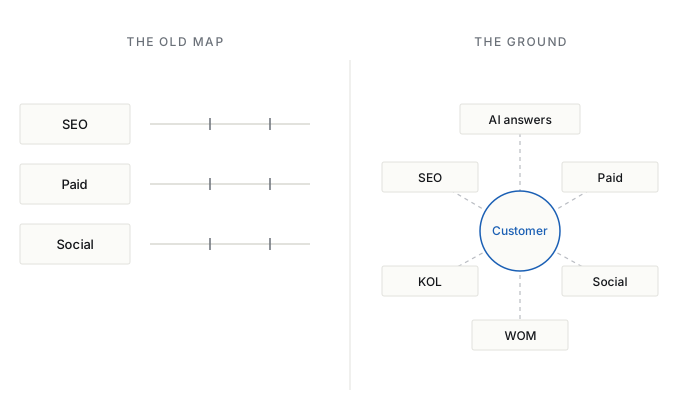
That does not work now because everything is mixed. AI Overviews, social, creators, paid media, word of mouth, AI search all touch each other before a customer shows up in your data. Attribution was never perfect, but it is not even good enough anymore. Running budgets as if it still is means moving money toward whatever channel is best at claiming credit.
One thing is still the same. Paid ads aimed at people already close to buying can give fast, trackable results. Use them for that. But don't expect the same speed from everything else. Brand, content, creators, SEO: none of them gives you a trackable result in a couple of days. They compound on a longer clock and make everything else cheaper. Awareness lowers paid CAC. It lifts organic.
So the unit of measurement has to change. Stop asking which channel did the work. Ask what the work changed. If you want to know whether awareness spend matters, test for it. Run the campaign against one group, hold another group back, compare total demand between them. Not the click report. This is lift testing, and it is slower, more expensive, and less flattering than a dashboard. Fund outcomes, and fund the systems that produce them. Not channels.
But lift testing is expensive and noisy. On the other hand, last-click survives because it is easy, it is already in the tool, and everyone understands it. So the question is whether you can tell when it starts lying to you.
Say, a channel's number moves and nothing else in the business moves with it. That is spend shifting between buckets, not new demand. Or you cut the spend and demand holds anyway, meaning you were paying for what the market would have given you for free. If you cannot see those moments, you are optimizing toward a number that stopped meaning anything.
How are you checking whether your cheapest measurement is still telling you the truth?